
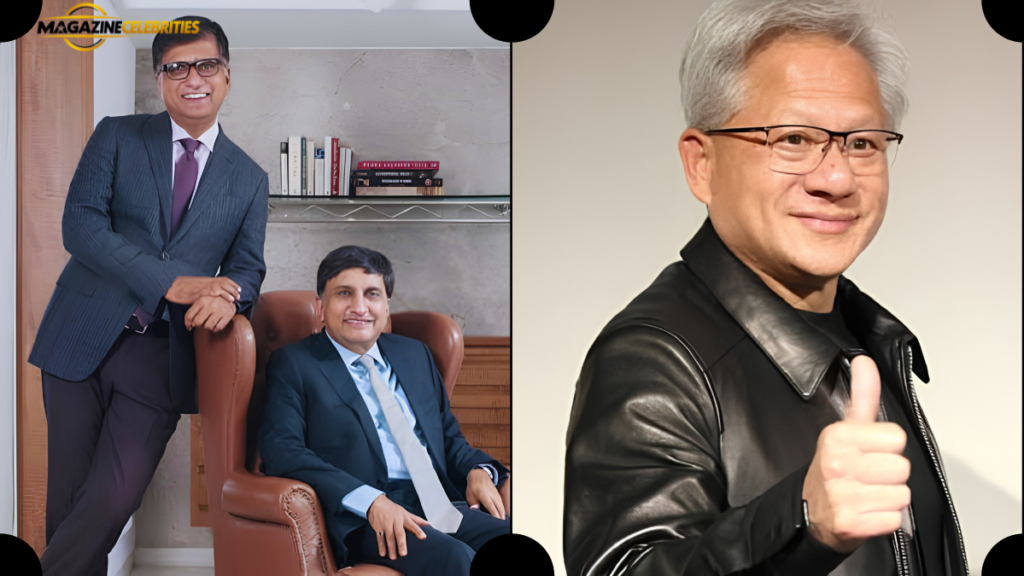

The names Dilip Shanghvi and Jensen Huang belong to two very different worlds. Shanghvi built his reputation in pharmaceuticals, creating Sun Pharmaceutical Industries and turning it into a major global healthcare company. Huang, meanwhile, became one of the most influential figures in modern technology through NVIDIA, the semiconductor company he co-founded and continues to lead.
At first glance, there may not seem to be much connecting these two entrepreneurs. One built a career around medicines, healthcare, acquisitions, and pharmaceutical research, while the other built his around computer chips, accelerated computing, graphics processing, and artificial intelligence. Yet their stories have an important similarity: both spent decades building businesses around long-term ideas rather than chasing short-lived success.
There is also an important point to clarify when people search for “Dilip Shanghvi and Jensen Huang” together. There is no well-established public evidence of a direct business partnership, family relationship, or major joint venture between the two. Their names are more useful when viewed as a comparison between two founder-led success stories.
Who Is Dilip Shanghvi?
Dilip Shanghvi is the founder and Executive Chairman of Sun Pharmaceutical Industries. His career is one of the strongest examples of how a relatively focused pharmaceutical Dilip Shanghvi and Jensen Huang business can grow into an international company through specialization, expansion, acquisitions, and persistent strategic planning.
Shanghvi’s background was connected to the pharmaceutical trade before he became an entrepreneur on a much larger scale. He studied commerce at the University of Calcutta, giving him a business-oriented educational foundation rather than a traditional scientific or medical one. His eventual success in pharmaceuticals therefore came largely through his ability to understand markets, products, business opportunities, and long-term company strategy.
Sun Pharma began as a much smaller operation than the company known today. The business initially concentrated on psychiatric medicines and gradually expanded its product portfolio and international reach. That focused beginning became an important part of Shanghvi’s business philosophy: rather than attempting to compete everywhere immediately, the company developed expertise in selected areas and expanded from there.
Today, Shanghvi’s official role is Executive Chairman of Sun Pharma. He previously served as Managing Director but stepped away from that position in September 2025. The change allowed him to continue contributing to the company’s broader strategic direction while a new Managing Director took responsibility for day-to-day executive leadership.
Who Is Jensen Huang?
Jensen Huang is the co-founder, President, and Chief Executive Officer of NVIDIA. Unlike Shanghvi, Huang entered entrepreneurship from a strongly technical background. His education and early career were centered on electrical engineering and semiconductor technology.
Huang earned an electrical engineering degree from Oregon State University and later completed a master’s degree in electrical engineering at Stanford University. Before establishing NVIDIA, Dilip Shanghvi and Jensen Huang he worked at major semiconductor companies, including AMD and LSI Logic. Those experiences gave him a close understanding of the technology industry before he became a founder himself.
In 1993, Huang co-founded NVIDIA with Chris Malachowsky and Curtis Priem. The company initially became known for graphics technology, particularly as computing and gaming demanded increasingly sophisticated visual processing. Over time, however, NVIDIA’s technology developed far beyond its original graphics focus.
One of the most important changes came as graphics processors became useful for highly parallel computing tasks. NVIDIA’s CUDA platform helped developers use its processors for applications outside traditional graphics. This became particularly important as machine learning and artificial intelligence began demanding enormous amounts of computational power.
Huang has remained NVIDIA’s President and CEO since the company’s founding. That makes his tenure unusual even among successful technology executives. He has not simply founded a company and moved into a ceremonial role; he has remained deeply involved in its strategic direction for more than three decades.
Dilip Shanghvi and Jensen Huang Took Different Routes to Success
The biggest difference between Dilip Shanghvi and Jensen Huang is the industries they chose.
Shanghvi built his career in pharmaceuticals, an industry where product development, regulation, manufacturing, intellectual property, clinical research, distribution, and patient needs all influence business decisions. His approach has included organic expansion as well as significant acquisitions that helped Sun Pharma broaden its capabilities and geographic presence.
Huang’s world is different. Semiconductor companies depend heavily on engineering, chip architecture, software ecosystems, manufacturing partnerships, computing platforms, and enormous research and development investments. NVIDIA’s evolution demonstrates how a company can begin with one market and eventually become important to a much wider technological ecosystem.
Despite these differences, both founders understood the importance of positioning their companies for markets that could become significantly larger over time. Shanghvi expanded Sun Pharma beyond its early specialist focus, while Huang pushed NVIDIA’s technology beyond conventional graphics into accelerated computing and AI infrastructure.
That ability to think beyond the original business model is one of the strongest similarities between their careers.
The Importance of Long-Term Thinking
Both entrepreneurs demonstrate that major companies are rarely built overnight.
Shanghvi’s rise was based on decades of decisions. Sun Pharma expanded into additional therapeutic areas, international markets, and larger pharmaceutical opportunities. The acquisition of Ranbaxy became one of the most significant milestones in the company’s history and substantially increased its global scale.
Huang’s story also took decades. NVIDIA was founded in 1993, but the company’s importance to artificial intelligence did not appear immediately. Its early identity was closely associated with graphics and gaming. The broader value of GPU-based parallel computing became clearer as scientific computing, machine learning, and AI applications developed.
This is where the comparison becomes especially interesting. Neither founder’s ultimate success can be explained by a single product or one lucky decision. Their companies evolved repeatedly as technology, markets, and customer needs changed.
For entrepreneurs, that may be one of the most valuable lessons from comparing Dilip Shanghvi and Jensen Huang. Building a successful company is not necessarily about predicting every future development correctly. It is about creating enough capability and strategic flexibility to take advantage of important changes when they arrive.
Leadership Styles and Business Philosophy
Shanghvi and Huang also represent different approaches to leadership.
Shanghvi’s reputation has often been associated with a relatively measured and analytical style. Pharmaceutical businesses require careful decisions because mistakes can involve significant financial, regulatory, and operational consequences. His career demonstrates the importance of patience, disciplined expansion, and evaluating opportunities over a long time horizon.
Huang is much more publicly associated with technology-driven transformation. NVIDIA’s evolution required significant confidence in the future importance of accelerated computing. The company invested heavily in both hardware and software, creating an ecosystem that could support developers and businesses rather than relying only on individual chip sales.
There is a common thread underneath both approaches: neither founder built a company around constant reinvention for publicity. Their most important changes were connected to fundamental shifts in their industries.
Shanghvi understood that pharmaceuticals could become increasingly specialized and international. Huang recognized that processors designed for parallel workloads could become useful far beyond traditional computer graphics. In both cases, strategic patience played a major role.
Their Companies Have Reached Different Kinds of Global Influence
Sun Pharma and NVIDIA are influential for very different reasons.
Sun Pharma’s importance comes from healthcare. Medicines affect patients, doctors, hospitals, pharmacies, and healthcare systems around the world. Its growth has transformed it from a small pharmaceutical business into a major international drug company.
NVIDIA’s influence comes from computing infrastructure. Its processors and software platforms are now closely connected with demanding workloads involving artificial intelligence, data centers, scientific computing, graphics, and other advanced applications. NVIDIA’s recent financial results demonstrate just how dramatically the company has grown around data-center and AI demand.
The contrast is striking. One company contributes to the healthcare supply chain, while the other provides technology that helps power modern computing. Yet both businesses depend heavily on knowledge, research, specialized talent, and the ability to make decisions years before the full commercial results become obvious.
What Entrepreneurs Can Learn From Dilip Shanghvi and Jensen Huang
There are several practical lessons in their careers.
The first is the value of specialization. Shanghvi did not begin by trying to dominate every area of pharmaceuticals. Sun Pharma developed expertise in selected therapeutic areas and expanded gradually. Huang similarly built NVIDIA around specialized computing technology before its applications became much broader.
The second lesson is patience. Both companies required years of investment before their eventual global importance became clear. Entrepreneurs often want immediate validation, but large businesses can take decades to reach their full potential.
The third lesson is adaptability. Neither Sun Pharma nor NVIDIA remained exactly the same company they were at the beginning. Successful organizations have to change as markets develop.
Finally, both careers show that founders do not necessarily need identical backgrounds to become effective business leaders. Shanghvi came from commerce and built a pharmaceutical empire. Huang came from engineering and helped create a technology powerhouse. Their educational paths were different, but both developed deep knowledge of the industries they entered.
Are Dilip Shanghvi and Jensen Huang Connected?
There is currently no strong public evidence establishing a direct personal, family, or business relationship between Dilip Shanghvi and Jensen Huang.
The reason their names may appear together is largely comparative. Both are highly successful founders who built globally important companies, and both remained influential in their organizations for decades.
Their stories are therefore better understood as two separate examples of entrepreneurial leadership rather than as a story about a partnership. Shanghvi represents the long-term development of a pharmaceutical enterprise, while Huang represents the transformation of a semiconductor company into a major force in accelerated computing and artificial intelligence.
Final Thoughts
Dilip Shanghvi and Jensen Huang followed completely different professional paths, but their careers share a surprisingly similar foundation: focus, patience, industry knowledge, and a willingness to invest in opportunities before their full potential was obvious.
Shanghvi transformed a small pharmaceutical operation into Sun Pharma, using specialization, international growth, and acquisitions to build scale. Huang helped transform NVIDIA from a graphics-focused company into a critical player in modern computing and artificial intelligence.
Their stories also demonstrate why comparing successful entrepreneurs is more useful than simply comparing their wealth or public profiles. The real lesson is how they built lasting organizations.
Neither career was defined by one moment alone. Their achievements were created through decades of decisions, adjustments, risks, failures, investments, and strategic choices. That is ultimately what makes Dilip Shanghvi and Jensen Huang such interesting names to study together: they prove that there is more than one way to build a global business, but lasting success usually requires a long-term vision and the discipline to pursue it.